He Changes Times And Seasons › Daniel 5
CHAPTER 5
The Handwriting on the Wall
Weighed in the balances and found wanting
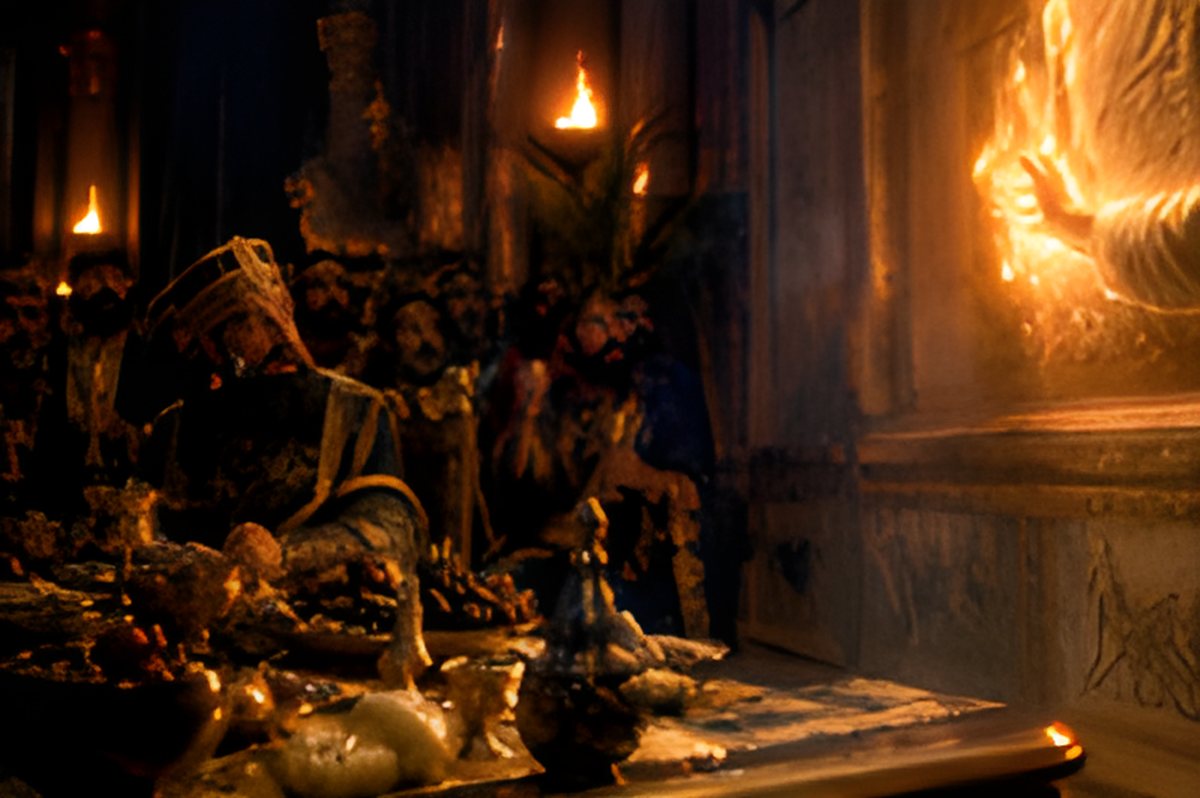
Chapter 5 jumps forward twenty-three years from chapter 4, to the night of October 12, 539 B.C. Babylon is under siege by the Medo-Persian army, yet the king gives a banquet as if nothing threatens him. The story is brief and terrible, and the phrase “handwriting on the wall” has entered every language.
Archaeology confirmed what critics once doubted: a king named Belshazzar did exist, as the son and co-regent of Nabonidus, who was away from the city. That explains why Belshazzar can offer Daniel only the third place in the kingdom (v. 16).
The Feast and the Sacred Vessels
DANIEL 5:1–4
1Belshazzar the king made a great feast to a thousand of his lords, and drank wine before the thousand.
2Belshazzar, while he tasted the wine, commanded to bring the golden and silver vessels which Nebuchadnezzar his father had taken out of the temple which was in Jerusalem; that the king and his lords, his wives and his concubines, might drink therefrom.
3Then they brought the golden vessels that were taken out of the temple of the house of God which was at Jerusalem; and the king and his lords, his wives and his concubines, drank from them.
4They drank wine, and praised the gods of gold, and of silver, of brass, of iron, of wood, and of stone.
Belshazzar makes a great feast for a thousand of his lords and drinks wine in their presence. Under the influence of wine, he commands that the gold and silver vessels Nebuchadnezzar took from the temple in Jerusalem be brought in so that the king, his lords, his wives, and his concubines may drink from them.
It is a deliberate act of defiance. He knew the history of his predecessor’s humbling and chose to profane what had been dedicated to the living God. While praising the gods of gold, silver, bronze, iron, wood, and stone, he mocks the God who made them all.
The Fingers of a Man’s Hand
DANIEL 5:5–9
5In the same hour came forth the fingers of a man’s hand, and wrote over against the candlestick upon the plaster of the wall of the king’s palace: and the king saw the part of the hand that wrote.
6Then the king’s countenance was changed in him, and his thoughts troubled him; and the joints of his loins were loosed, and his knees smote one against another.
7The king cried aloud to bring in the enchanters, the Chaldeans, and the soothsayers. The king spake and said to the wise men of Babylon, Whosoever shall read this writing, and show me the interpretation thereof, shall be clothed with purple, and have a chain of gold about his neck, and shall be the third ruler in the kingdom.
8Then came in all the king’s wise men; but they could not read the writing, nor make known to the king the interpretation.
9Then was king Belshazzar greatly troubled, and his countenance was changed in him, and his lords were perplexed.
In the same hour the fingers of a man’s hand come forth and write on the plaster of the wall of the king’s palace, over against the lampstand, and the king sees the part of the hand that writes. His countenance changes, his thoughts trouble him, the joints of his loins are loosed, and his knees smite one against another.
The king cries aloud for the enchanters, Chaldeans, and soothsayers, offering scarlet, a chain of gold, and the third place in the kingdom to anyone who can read the writing. They cannot. Once again the wisdom of Babylon fails, and the king and his lords are greatly perplexed. Earlier mockery turns to terror in a single moment.
The Queen’s Counsel and Daniel’s Summons
DANIEL 5:10–16
10Now the queen by reason of the words of the king and his lords came into the banquet house: the queen spake and said, O king, live for ever; let not thy thoughts trouble thee, nor let thy countenance be changed.
11There is a man in thy kingdom, in whom is the spirit of the holy gods; and in the days of thy father light and understanding and wisdom, like the wisdom of the gods, were found in him; and the king Nebuchadnezzar thy father, the king, I say, thy father, made him master of the magicians, enchanters, Chaldeans, and soothsayers;
12forasmuch as an excellent spirit, and knowledge, and understanding, interpreting of dreams, and showing of dark sentences, and dissolving of doubts, were found in the same Daniel, whom the king named Belteshazzar. Now let Daniel be called, and he will show the interpretation.
13Then was Daniel brought in before the king. The king spake and said unto Daniel, Art thou that Daniel, who art of the children of the captivity of Judah, whom the king my father brought out of Judah?
14I have heard of thee, that the spirit of the gods is in thee, and that light and understanding and excellent wisdom are found in thee.
15And now the wise men, the enchanters, have been brought in before me, that they should read this writing, and make known unto me the interpretation thereof; but they could not show the interpretation of the thing.
16But I have heard of thee, that thou canst give interpretations, and dissolve doubts: now if thou canst read the writing, and make known to me the interpretation thereof, thou shalt be clothed with purple, and have a chain of gold about thy neck, and shalt be the third ruler in the kingdom.
The queen (most likely the queen mother, who could remember the days of Nebuchadnezzar) enters the banquet hall and calms the king. She reminds him of a man in the kingdom in whom is the spirit of the holy gods, whom Nebuchadnezzar made master of the magicians, and who has light, understanding, and excellent wisdom. Daniel is brought in.
By now Daniel is an old man, probably over eighty, long set aside from the center of power. The king offers him honors, and Belshazzar admits that he has heard that Daniel can give interpretations and dissolve doubts.
Daniel’s Rebuke
DANIEL 5:17–24
17Then Daniel answered and said before the king, Let thy gifts be to thyself, and give thy rewards to another; nevertheless I will read the writing unto the king, and make known to him the interpretation.
18O thou king, the Most High God gave Nebuchadnezzar thy father the kingdom, and greatness, and glory, and majesty:
19and because of the greatness that he gave him, all the peoples, nations, and languages trembled and feared before him: whom he would he slew, and whom he would he kept alive; and whom he would he raised up, and whom he would he put down.
20But when his heart was lifted up, and his spirit was hardened so that he dealt proudly, he was deposed from his kingly throne, and they took his glory from him:
21and he was driven from the sons of men, and his heart was made like the beasts’, and his dwelling was with the wild asses; he was fed with grass like oxen, and his body was wet with the dew of heaven; until he knew that the Most High God ruleth in the kingdom of men, and that he setteth up over it whomsoever he will.
22And thou his son, O Belshazzar, hast not humbled thy heart, though thou knewest all this,
23but hast lifted up thyself against the Lord of heaven; and they have brought the vessels of his house before thee, and thou and thy lords, thy wives and thy concubines, have drunk wine from them; and thou hast praised the gods of silver and gold, of brass, iron, wood, and stone, which see not, nor hear, nor know; and the God in whose hand thy breath is, and whose are all thy ways, hast thou not glorified.
24Then was the part of the hand sent from before him, and this writing was inscribed.
Daniel does not flatter the king. Let your gifts be for yourself, he says, and give your rewards to another; nevertheless I will read the writing to the king and make known the interpretation. He first reminds Belshazzar what God did to his predecessor: the Most High God gave Nebuchadnezzar the kingdom, majesty, and glory, and when his heart was lifted up he was driven from men until he knew that the Most High rules.
Then comes the indictment: And thou his son, O Belshazzar, hast not humbled thy heart, though thou knewest all this. Belshazzar had lifted himself against the Lord of heaven, drunk wine from the temple vessels, praised gods that neither see nor hear nor know, and not glorified the God in whose hand his breath is and whose are all his ways. Therefore the part of the hand was sent from Him and the writing was inscribed. The word “son” here has the same sense as in other Semitic languages: descendant or successor.
MENE, MENE, TEKEL, UPHARSIN
DANIEL 5:25–28
25And this is the writing that was inscribed: MENE, MENE, TEKEL, UPHARSIN.
26This is the interpretation of the thing: MENE; God hath numbered thy kingdom, and brought it to an end.
27TEKEL; thou art weighed in the balances, and art found wanting.
28PERES; thy kingdom is divided, and given to the Medes and Persians.
The writing is four words in the original: Mene, Mene, Tekel, Upharsin. Daniel interprets. Mene: God has numbered thy kingdom and brought it to an end. Tekel: thou art weighed in the balances and art found wanting. Peres (the singular form of Upharsin): thy kingdom is divided and given to the Medes and Persians.
The three words correspond to three weights or coins (the mina, the shekel, and the half-shekel), but Daniel reads them as verbs. God has counted the days, weighed the character, and divided the realm. Judgment by the unseen Judge is exact.
The Fall of Babylon
DANIEL 5:29–31
29Then commanded Belshazzar, and they clothed Daniel with purple, and put a chain of gold about his neck, and made proclamation concerning him, that he should be the third ruler in the kingdom.
30In that night Belshazzar the Chaldean king was slain.
31And Darius the Mede received the kingdom, being about threescore and two years old.
Belshazzar keeps his word and Daniel is clothed with scarlet, a chain of gold is put on his neck, and a proclamation makes him the third ruler in the kingdom. In that same night Belshazzar the Chaldean king is slain, and Darius the Mede receives the kingdom, being about sixty-two years old.
Historically, Babylon fell to the forces of Cyrus, whose general Ugbaru (Gobryas) entered the city without a battle after diverting the Euphrates. The identity of “Darius the Mede” is debated: he may be Ugbaru, a Median governor appointed by Cyrus, or another name for Cyrus himself. What is certain is that the empire of gold gave way to the empire of silver exactly as chapter 2 said it would.
Discussion Questions
- Why was Belshazzar judged more severely than Nebuchadnezzar?
- What do the words Mene, Tekel, and Peres teach about God’s judgment?
- How does Daniel speak truth to a powerful man without fear or flattery?
- What in your life would be found wanting if weighed today?